
Article Contents
Thinking about a 10 GB data eSIM but not sure if it's enough? You don't have to guess. How far 10 GB goes depends on how you use your phone. This guide gives you a clear picture of whether a 10 GB plan fits your needs.
How much is 10 GB?
10 GB equals 10,240 MB (using binary units, where 1 GB is about 1,024 MB). To put that in everyday terms, 10 GB is roughly:
- about 3,000 photos at normal quality
- around 2,000 MP3 music files
What can you do with 10 GB per month?
Research shows that the average smartphone user uses around 5 to 8 GB per month. That means 10 GB is more than enough for most people. You'll have room to spare.
With 10 GB of data in a month, you can comfortably:
- Browse websites for about 5 hours every day
- Scroll social media for around 3 hours every day
- Stream music on Spotify at normal quality for 2 hours every day
- Watch YouTube at 480p for about 70 minutes every day
- Use Google Maps navigation for around 16 hours total in the month
Keep in mind that doing several of these things at once will use up your data faster. If you connect to WiFi regularly, your 10 GB will last much longer.
How long does a 10 GB plan last?
It depends on how you use your phone. Here are three common types of users:
- Light user
"I check messages, use navigation, and search the web now and then."
100 MB per day = about 100 days
- Average user
"I stay in touch on social media, listen to music on the go, and use maps sometimes."
360 MB per day = about 28 days
- Heavy user
"I watch videos daily, stream live content, post on social media, and use navigation constantly."
2,500 MB per day = about 4 days
The key is knowing your own habits. Track your data use for a few days. That will give you a much clearer idea of how much you actually need.
How much data do popular apps use?
Apps vary a lot in how much data they use. Streaming services and video-heavy social apps use the most. YouTube at 480p uses about 300 MB per hour. TikTok can use up to 840 MB per hour because it constantly loads new videos.
Data usage by app


As you can see, video content uses the most data. Even with a 10 GB plan, it's worth lowering the video quality or downloading content over WiFi before you watch.
How do I check how much data I've used?
Most eSIM providers have apps where you can check your remaining data in real time.
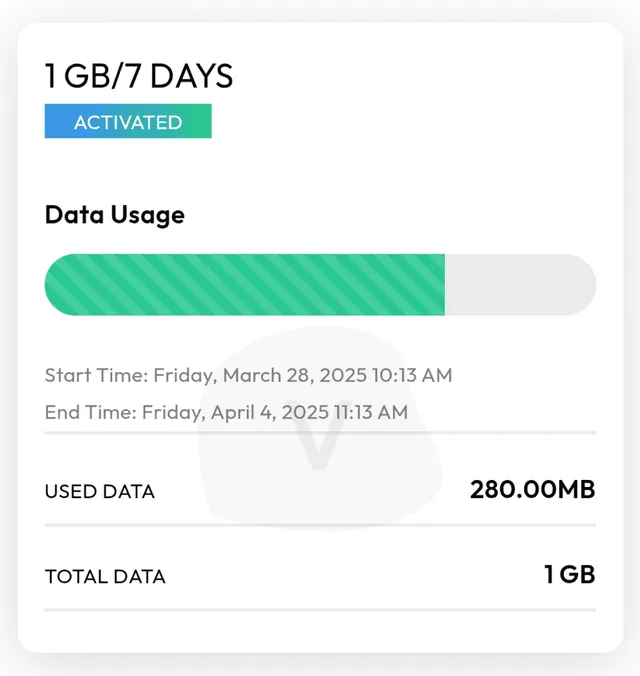
Keeping an eye on your data helps you get the most from your plan. Most modern phones make this easy.
On iOS:
- Go to Settings → Mobile Data
- Scroll down to see how much data each app has used
- You can set a data limit and get alerts when you're getting close
On Android:
- Go to Settings → Network & Internet → Data Usage
- You'll see a breakdown of which apps use the most data
- You can set data warnings and limits from there too
Tips to save mobile data
Want your 10 GB to last as long as possible? Try these simple steps:
- Download content over WiFi ahead of time - music, videos, and offline maps
- Lower the streaming quality on Spotify, YouTube, or Netflix
- Turn off auto-play videos on social media apps
- Restrict background app updates to WiFi only
- Use lite versions of apps like YouTube Go, Facebook Lite, or Twitter Lite
- Turn on data saver mode in your phone settings or in individual apps
The single most effective way to save mobile data is to connect to WiFi whenever you can. At home, at the office, in cafes, or at shopping centers, every WiFi session keeps your data plan intact.
Find more detailed tips on saving data in this article.
Where can I find 10 GB plans for any country?
Whether you're planning a trip abroad or looking for a reliable data eSIM for daily use, check out the vefru eSIM plan comparison. It covers a wide range of destinations and makes it easy to find a plan that matches what you actually need.
Pick a data plan that fits how you use your phone. If you're an average user, 10 GB gives you plenty of headroom. If you stream a lot or use heavy apps, you may want to go bigger. With a travel eSIM, you get instant connection the moment you land. No fuss, no roaming fees, no hunting for a local SIM card.
Frequently Asked Questions
Is 10 GB enough for a vacation?
Which app uses the most data?
How will I know when I'm running low on data?
Can I buy more data if I run out of my 10 GB?
How long does 10 GB last when watching Netflix?
Is 10 GB enough for a work trip?
What is the difference between 10 GB and unlimited data?

What is eSIM?
eSIM allows you to use a digital SIM card instead of a traditional plastic one. This enables you to purchase a SIM card online for the country you're traveling to.
The most well-known eSIM providers on the market are Airalo, Holafly, eSIM4Travel, Yesim, Saily and others.
Frequently asked questions about eSIM:
- Does my phone have eSIM?
- How to add eSIM to iPhone or Samsung?
- How to install eSIM on an older phone?
- What are the most affordable and best phones with eSIM support?

How to compare eSIM?
Here you can compare eSIM data packages for more than 200 countries, such as UK, USA, Egypt and others. And that for any duration and amount of data.
Along with additional information, such as provider ratings and whether the website is available in Czech.
Compare all eSIMs
Why can you trust Vefru?
Founders František and Jan experienced problems with mobile data every time they traveled outside the EU. As technology enthusiasts, the idea of traveling abroad without a data connection or risking truly insane roaming fees was unacceptable to them. Regardless of how adventurous the story of walking across Toronto on a winter night without an online map might be, it's not something they would want to repeat.
After the emergence of eSIM and later eSIM travel data package providers, they learned a lot about the technology and industry and decided to share their findings and the comparison tool they created for themselves with others. It now contains more than 20,000 updated eSIM mobile data packages from the most popular providers for more than 170 countries around the world.
Every time you read a guide on Vefru, it is created in the same way the author would research the topic themselves. From contacting locals about the best network operators, to recommending the most advantageous plans for what you really need, to technical guides on how to create a QR code for eSIM or how to troubleshoot eSIM issues. Most articles are created based on topics that the authors themselves have dealt with and for which they found the best solutions.

Technology experts
instead of copywriters

We test everything we
write about

We compare 20 thousand
eSIM data packages